The Invisible Barrier
Imagine stepping back into 18th-century France. The aristocrats of the time owned sprawling, magnificent estates. They looked out from their manors and wanted to visually claim the vast expanse of rolling terrain in front of them as a seamless part of their own property. They wanted the sweeping view, but they wanted the commoners kept out.Their clever solution? The Ha-ha wall!
What exactly is a Ha-ha?
When you map out a Ha-ha visually, you can see it is essentially a sunken trench. One side slopes gently downward, while the other side is a sheer vertical retaining wall. From a distance, the drop is completely invisible. The eye travels right over it, creating the beautiful illusion of a continuous, unbroken landscape.
Interestingly, this wasn't originally an aristocratic invention. It was first designed by French peasants. They needed a way to restrict their livestock to specific grazing areas so the animals wouldn't trample their manicured gardens, while still keeping the flocks in plain sight. The aristocrats simply reinterpreted this humble agricultural tool, turning it into an invisible fortress to keep people off their lawns.
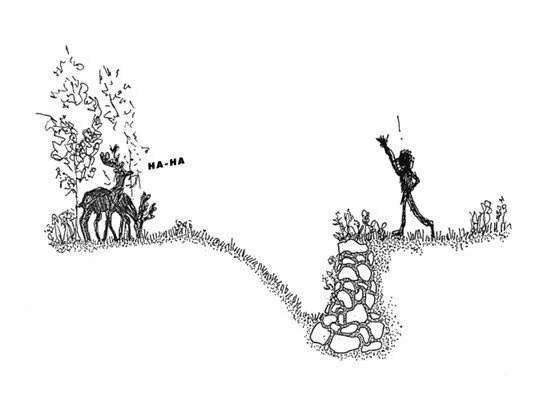
Diagram of a ha-ha wall
The Hidden Challenges of the Ha-ha
While it looks effortless and natural on the surface, building a Ha-ha requires immense precision. There are major challenges hidden within the design:
Drainage and Geology: If the trench is designed without a deep understanding of the local terrain and water flow, water can stagnate at the bottom. This leads to unhygienic conditions and turns the ditch into a breeding ground for mosquitoes.
The Gradient: If the sloping side of the ditch isn't maintained with the exact right angle, animals can easily slip down and get trapped at the bottom.
Structural Integrity: The retaining wall holds back a massive amount of earth. If it is not constructed properly, the entire wall can easily collapse.
Space Consumption: A Ha-ha requires a substantial amount of land to achieve that gentle, deceptive slope, taking up far more space than simply erecting a standard fence.
The Ha-ha in the Modern Context
Despite these structural challenges, the Ha-ha remains a brilliant spatial tool. Today, it is highly useful for creating a dignified, open foreground for monuments or important civic buildings. It provides the necessary security and prevents trespassing, entirely without creating a hostile, fortress-like visual barrier.
Even on a smaller scale, miniature versions of the Ha-ha can be integrated into our residential landscapes to keep snakes and creeping invertebrates from entering our indoor spaces, allowing us to stay deeply connected to our surroundings while maintaining a safe, unseen boundary.